Family
How Big Families Coordinate Gifts Without Duplicates
Big families avoid duplicate gifts with one shared list per person and one habit: mark a gift the moment you commit to it. Group texts can’t do that job, because the message about the Lego set is buried under pie photos by Thursday. Here’s a sample plan for a family of 12, how to handle big gifts several people chip in on, and how to keep the kids from seeing any of it.
Why the group text stops working
A family group chat is fine for flight times. For gifts it has two problems. The information scrolls away, so your sister in Denver never sees that your mom already called dibs on the scooter. And one parent turns into a switchboard, answering the same “what does Emma want?” from four relatives in one week and trying to remember who said what.
Most duplicates aren’t careless. They happen because two people had the same sensible idea for the same nine-year-old on the same Saturday. The fix is a place where the second person can see that the first one already got there.
One list per kid, one link per list
Give each child a separate list. A single family spreadsheet sounds tidy, but somebody has to own it, and that somebody is usually the same parent who was the switchboard. With one list per kid, a grandfather shopping for Noah sees Noah’s wishes and nothing else, and sizes don’t get mixed up between cousins.
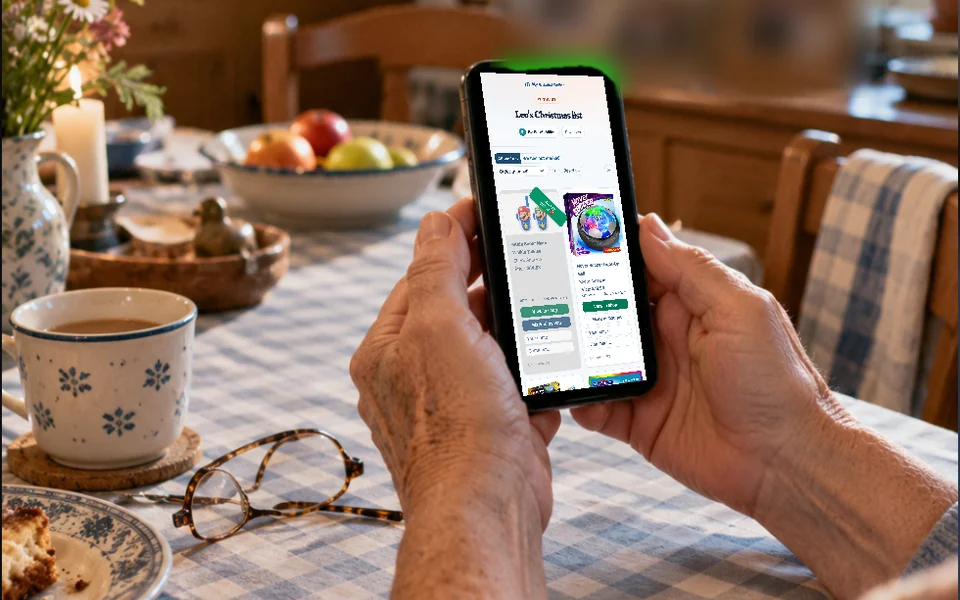
Set one deadline: lists up by the Sunday after Thanksgiving, which is November 29 this year. After that, the rule fits in a sentence. Decide what you’re buying, open the list, mark it before you check out. Our Christmas lists work this way: relatives open a link in any browser, without installing anything, and tap “Mark as bought.”
A sample gift plan for a family of 12
Here’s how it can look for Grandma and Grandpa, three grown siblings with their spouses, and four grandkids. Change the amounts to suit your family. The part worth copying is the order in the last column.
| Who | Buys for | Budget | When they pick |
|---|---|---|---|
| Grandma and Grandpa | Each grandkid, one bigger gift | $75 a kid | First, by November 30 |
| Aunts and uncles | Each niece and nephew | $25 a kid, per couple | Second, by December 6 |
| Parents | Their own kids | Their call | Last, once the relatives have picked |
| All eight adults | One drawn name | $50 | Names drawn at Thanksgiving |
| The four cousins | One drawn name | $10, with a parent’s help | By mid-December |
Why the order matters
Grandparents go first because they’re buying the biggest gift and usually have the strongest feelings about it. Aunts and uncles go next. Parents fill the gaps last, since they know what a kid still needs and what got skipped.
A staggered schedule also stops the worst kind of duplicate, the one where a parent and a grandparent both buy the main gift. If you own the list, plan to check what’s left around December 7, and do it when small eyes aren’t on your phone.
For the adults, drawing names cuts the shopping down to one person each. If the family’s spread across several states, an online draw does the same job as the hat.
Big gifts several people split
When a $120 bike is on the list, one person marks the wish and everyone else sees it as taken. Who pays what stays in the group text, because a shared list can’t split money or collect it. Name one buyer, agree on the amounts before that person orders, and settle up with whatever payment app you already use.
Say the buyer is Aunt Megan, with Uncle Mike and Grandma each owing her $40. That takes one message in the chat and no spreadsheet. It’s also a good moment to agree on who brings the helmet, since nobody thinks of it until Christmas morning.
Keeping the kids out of it
Your own view of a list stays clean. In our app, no mark appears on your list unless you turn on “Show me ‘bought’ marks,” and you don’t get a notification when a gift is marked. That’s the setting to use for your December 7 check. The shared link is different. It shows everyone what’s already gifted, so a kid who opens it sees that too.
Send links to adults only, and remind grandparents not to forward them to an 11-year-old with a phone. Comments on a wish also reach the list’s owner, so nobody should write “got this one!” there.
Getting gifts there from out of state
Relatives who live far away should ship to whoever’s hosting. Lists don’t hold shipping addresses, so text the address directly. Don’t put it in a list description, where everyone with the link can read it.
For delivery before Christmas in the lower 48, USPS recommends sending Ground Advantage and First-Class Mail by December 17 and Priority Mail by December 18. Those dates are recommendations, so aim for the week before. Ask everyone to include a gift receipt, because if a duplicate does slip through, that makes the return painless.
The same system for birthdays
Once the family has the habit, it carries over. Kids’ birthdays are the next test, this time with classmates’ parents in the mix, and kids’ birthday wishlists work the same way as the ones in December.
Common questions
How do you stop two people from buying the same gift?
Keep one shared list per person and have everyone mark a gift before they check out. A group text can’t do this, because nobody scrolls back. Whichever tool you use, the habit is what prevents duplicates.
Should each kid have their own wish list?
Yes. A separate list per child keeps ages and sizes straight, and you can share each one with the people who buy for that child. Parents keep the lists for younger kids.
How much should aunts and uncles spend on nieces and nephews?
There’s no rule. What matters is picking one number for every kid, so nobody opens something much bigger than their cousin. Our sample plan uses $25 per child, per couple.
Sources
- USPS: 2026 Holiday Shipping Deadlines (checked October 31, 2026)
- USPS: Postal Service Recommends 2026 Holiday Mailing and Shipping Dates (checked October 31, 2026)